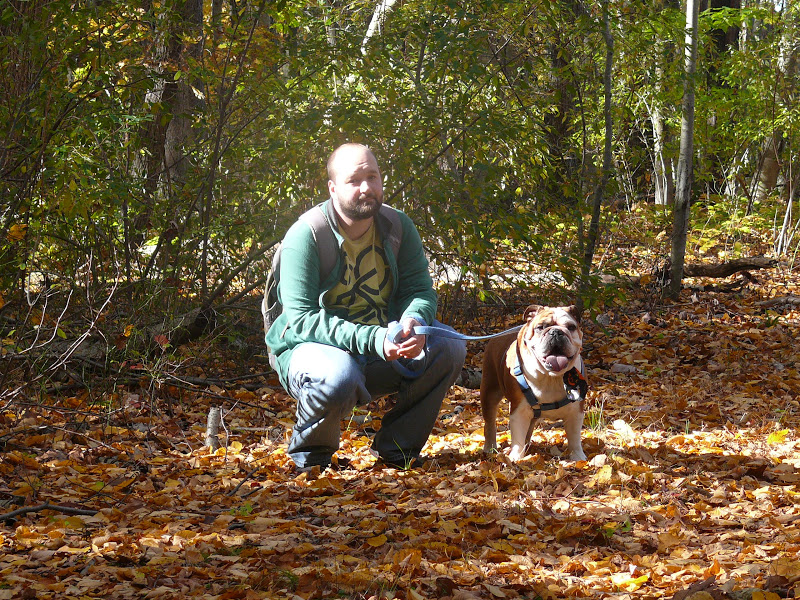
"Dogs are our link to paradise. They don't know evil or jealousy or discontent. To sit with a dog on a hillside on a glorious afternoon is to be back in Eden, where doing nothing was not boring - it was peace." - Milan Kundera (b. 1929) Czech author
On Sunday morning we decided to take the Weasley, Bob, and Tubby for a hike on the Hackenberry Trail about an hour drive from our home. It was a very pretty walk with lovely views of the foliage.
The walk was nice and isolated, we didn't see another person or dog the entire time, and the dogs had a great time smelling all the trees and leaves. The trouble began when we got back to the car. See the woods where apparently filled with a major mischief maker, this guy:
The American deer tick, the pesky little bugger who carries Lyme disease. They love to hang out in
woods, tall grass, and leaves. With rising global temperatures they
are around more of the year and are becoming a bigger problem. These
days its not unusual to get ticks walking in a city park, but the
biggest risk comes from walking in the woods. So while walking through the woods of Norther New Jersey it is no surprise that we ran into plenty of them.
The dogs where covered, and I mean covered, with ticks. I have hard that ticks are becoming immune to Frontline and after today's experience I am definitely agree When we got home we spent at least an hour taking ticks of the dogs, thankfully none where engorged, so perhaps the Frontline is doing something.
Here is the best method for removing Ticks:
Removing Ticks that are Not Engorged:
1) Fill a jar with a lid with rubbing alcohol. 2) Comb the dog and check carefully for any ticks that are walking around the body. Pick them off and immediately put them in the jar. You can not crush a tick and kill it, you must drown it in the jar. Seal the lid on the jar tightly to prevent escape. 3) Make sure to check yourself as well, if there are lots of ticks on your dog there are probably ticks on you.
Removing Ticks that are Engorged
1) At this point you need a tick key. 2) The tick will usually look like a shiny lump or skin tag.
Here is the You Tube video showing how to remove the tick
If you find an engorged tick on your dog and you live in one of the areas where Lyme Disease is prevalent (In NJ about 50% of deer ticks are positive for Lyme) I would recommend taking your dog to the vet for a test. (If the ticks are not engorged you don't have to worry). The tests do not actually determine if your dog has an active Lyme disease infection, but they will see if your dog has antibodies to it. Remember if your dog has had the vaccine he will always test positive. In my opinion the vaccine in not the way to go as it is not a 100% effective but makes the test moot and evidence indicates that we are over vaccinating our dogs anyway. Not every dog exposed to Lyme and with a positive test gets an active Lyme disease infection, but it is still a good idea to treat with antibiotics because Lyme has been linked to kidney failure and lameness, as well as other health problems. Once a dog has been exposed to Lyme even if they are successfully treated their antibody titer may remain high for the rest of their life. I monitor Norbert's antibody levels yearly and they stay above normal. However, they went down by more then 50% after his initial treatment with antibiotics so now we just watch for an increase. If the levels go up again we will treat with more antibiotics.
Below is a map of the areas in the US most heavily effected by Lyme disease (though it says human risk, where there is risk to human their is risk to dogs, and actually more risk since dogs are lower to the ground, have hair, and love running through grass, leaves, and bushes.