Showing posts with label Historical Hounds. Show all posts

Sunday, November 17, 2013

Black and White Sunday-Happy Birthday Toto!

Today marks the birthday of Terry (later officially renamed Toto) who played Toto in the Wizard of Oz:

Bob celebrated by reading one of our favorite books:


Monday, September 23, 2013

Urban hounds-The Story of Old Drum

This is a repost from one we did last year but its one of our very favorite historical hounds stories so we couldn't resist sharing it again.

A Man's Best Friend is His Dog

Every dog lover knows the saying but not everyone knows about the legal battle that surrounds it.  September 23rd marks the 142 anniversary of  the Old Drum Court Case.  Old Drum was a beloved foxhound owned by Charles Burden who was shot to death by a neighboring sheep farmer, Leonidas Hornsby, who was also Burden's brother in law.   Burden was furious over his dog's death and immediately sued Burden.   The case dragged through the Missouri courts with the men on both sides appealing decisions until it finally reached the State Supreme Court.

In the Supreme Court Trial Burden was represented by George Graham Vest, a lawyer and politician who had served on the Confederate Senate during the civil war and supported the secession of Missouri from the Union.   Vest was a gifted orator and his closing arguments in the trial, known as "Eulogy on The Dog" won the case for Burden and have gone down as one of the most memorable speeches in US courtroom History:

Gentlemen of the jury: The best friend a man has in this world may turn against him and become his enemy. His son or daughter that he has reared with loving care may prove ungrateful. Those who are nearest and dearest to us, those whom we trust with our happiness and our good name, may become traitors to their faith. The money that a man has, he may lose. It flies away from him, perhaps when he needs it the most. A man’s reputation may be sacrificed in a moment of ill-considered action. The people who are prone to fall on their knees to do us honor when success is with us may be the first to throw the stone of malice when failure settles its cloud upon our heads. The one absolutely unselfish friend that a man can have in this selfish world, the one that never deserts him and the one that never proves ungrateful or treacherous is his dog.
Gentlemen of the jury: A man’s dog stands by him in prosperity and in poverty, in health and in sickness. He will sleep on the cold ground, where the wintry winds blow and the snow drives fiercely, if only he may be near his master’s side. He will kiss the hand that has no food to offer, he will lick the wounds and sores that come in encounters with the roughness of the world. He guards the sleep of his pauper master as if he were a prince. When all other friends desert, he remains. When riches take wings and reputation falls to pieces, he is as constant in his love as the sun in its journey through the heavens.
If fortune drives the master forth an outcast in the world, friendless and homeless, the faithful dog asks no higher privilege than that of accompanying him to guard against danger, to fight against his enemies, and when the last scene of all comes, and death takes the master in its embrace and his body is laid away in the cold ground, no matter if all other friends pursue their way, there by his graveside will the noble dog be found, his head between his paws, his eyes sad but open in alert watchfulness, faithful and true even to death.


A statue of Old Drum inscribed with Vest's speech was erected in 1958 and stands outside the court house in Warrensburg, Missouri 

Another monument was built in 1947 in Blue Springs, Missouri in the location that Drum's body was found after being shot.


Both monuments are frequently mentioned in guides to America's road side attractions.

Friday, July 12, 2013

Historical Hounds- Rags The WWI Hero

 
Image Source


Sunday marks an important event in canine military history.   On July 14, 1918 a small scruffy terrier mix named for his resemblance to a pile of abandoned rags was adopted as the mascot of the US 1st Infantry Division serving in Montmarte Paris during WWI.  Rags was found by an American soldier, Private James Donovan, who was serving on the front lines.   

Rags quickly charmed the soldiers with his cleverness and bravery.  Donovan taught him to salute the flag and perform other amusing tricks, a welcome diversion from the blood shed on the front lines.    Rags keen hearing meant that he could hear attacks coming before the soldiers and he would lay flat on his belly which warned the soldiers of the incoming artillery.  Most important, Donovan trained Rags to carry messages on his collar and the little dog delivered notes back and forth between the soldiers.  In July of 1918 Donovan's infantry was surrounded by Germans and Rags saved the day by sneaking out and delivering a message that resulted in Allied reinforcements coming to rescue the men.  Rags heroic rescue led to him being officially made the mascot of the division.

Sadly in October of 1918 Rags and Donovan where both injured in a German attack and suffered from gas poisoning.  They were treated in the same hospital in France and Rags made a remarkable full recovery, however Donovan was still very ill.  Eventually both Rags and Donovan where sent back to the US to Chicago where Donovan entered a hospital that specialized in treating victims of gas attack and Rags moved into the Fort Sheridan military base.  Sadly like many WWI soldiers Donovan could not recover from his injuries and died in 1919.  Rags continued to live at the base and was looked after by the many soldiers who knew of his bravery and special relationship with Donovan. 

In 1920 Rags was adopted by Major Raymond W. Hardenbergh, his wife, and two daughters who where charmed by the little dog.  Rags lived a remarkable additional 14 years before passing away in 1936 at the age of 20.   Rags was buried with military honors in Silver Srings, Maryland near Hardenbergh's home and a memorial was erected in his honor. 


Proof positive that a small dog can do great big things!

Monday, June 3, 2013

Historical Hounds-Pal, The Dog Who Played Lassie

This is a reprint from last year, but we thought we would share this story again:

http://upload.wikimedia.org/wikipedia/en/thumb/2/2f/Lassie_and_Joe.JPG/250px-Lassie_and_Joe.JPG

The phrase dogs in film brings to mind a few important names...Rin Tin Tin, Toto, Old Yeller and most definitely Lassie. In fact the name Lassie has become  synonymous with canine companionship.

But who was the canine actor playing Lassie?

In reality of course there where quite a few Lassies, all males.  The first, however, was Pal a rough collie born on June 4, 1940.   He was born into show biz at a Hollywood Kennel with famous parents and a lineage that traced back to England's greatest show collies.  

Despite his impressive background Pal was not an immediate success.  He was passed around among several Hollywood dog trainers who struggled to control his barking and chasing behaviors, with limited success.  Eventually a trainer, Rudd Weatherwax, saw the dog's potential and agreed to take him on.  Weatherwax new a film version of the popular novel Lassie Come Home was being made and he felt Pal was perfect for the part.  The makers of the film did not agree, however, to them Pal had the wrong look and they wanted a female dog for the role.  An appropriate show dog was selected and Pal was hired as a stunt dog.  

Fate intervened, while shooting a particularly dramatic stunt sequence in which Lassie swims in a raging river.  Pal's performance so impressed the film's Fred M. Wilcox that the decision was made to have him take over the starring role.    In fact Pal's work in that sequence caused the producers of the film  to invest more money in it, changing it from a low budget feature to a star status film.

Their investment paid off and Lassie Come Home became a huge box office success, as well one of the first films starring Elizabeth Taylor.  Six more Lassie films, all starring Pa,l followed and Collies quickly became one of the most popular breeds in the US with millions of children begging their parents for their own Lassie. 

 In 1954 Weatherwax and producer Robert Maxwell created a TV series for Lassie, changing the setting of the story from Scotland to America.  Pal had a key role in selecting the child actor who would take the role of the young boy, Jeff.  Pal at the advanced age of 14 appeared in the first two episodes of the series before retiring and being replaced by his son Lassie Jr.  

Pal lived an astonishing 18 years, all of them with Rudd Weatherwax who cherished him above all of the other animals he trained.  When Pal died in 1958 Weatherwax was heartbroken.  His son said: "It hit him very hard when Pal died. He buried him in a special place on the ranch and would often visit the grave. Dad would never again watch an MGM Lassie movie. He just couldn't bear to see Pal. He didn't want to have to be reminded of just how much he loved that dog."
http://upload.wikimedia.org/wikipedia/commons/thumb/f/f2/Rudd_Weatherwax_and_Lassie_1955.JPG/220px-Rudd_Weatherwax_and_Lassie_1955.JPG
Pal and Rudd Weatherwax his trainer and owner

A Special Request for Some Juju and Good Vibes-We get the results of Tubby and Ping's senior blood work today or tommorow and it always makes mom so nervous as we get older.  Also Bob appears to have injured his eyed making a vet trip today necessary, this is our second eye injury as Tubby just went to the vet yesterday we a scratched cornea.  If you could send some good thoughts that all will be well we would appreciate it.

Friday, May 24, 2013

Queen Victoria-Dog Loving Monarch

Who was the most dog crazy monarch in the entire history of the dog loving British empire?  A serious contender would be Queen Victoria, and today is the 194th anniversary of her birth.  


As a child Victoria's exalted status led to extreme isolation, and as such her only real friends where her dogs.  Victoria's most favorite dog was her spaniel Dash who was her constant companion.  After her coronation Victoria returned to the palace and gave Dash a bath. When she decided to marry Prince Albert it was partly due to his fondness for Dash, and Dash's for him.  When Dash died in 1840, Victoria had this inscription placed on his grave.


Here lies
DASH
The favourite spaniel of Her Majesty Queen Victoria
In his 10th year
His attachment was without selfishness
His playfulness without malice
His fidelity without deceit
READER
If you would be beloved and die regretted
Profit by the example of
DASH

Dash was certainly not Victoria's only pet.   Throughout her reign she was surrounded by pets.  Including ponies, parrots, goats, and donkeys.


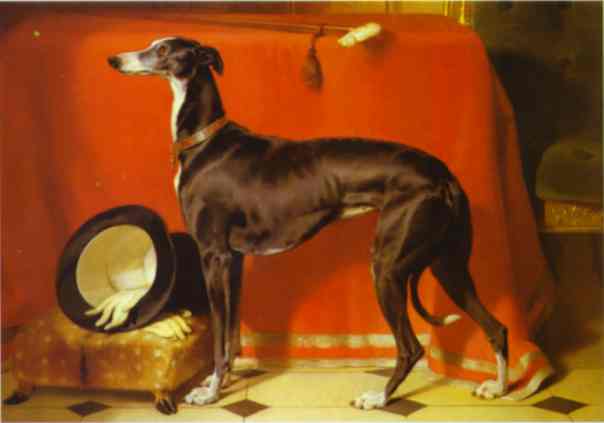
However dogs where always her particular favorite.  There where greyhounds:

Terriers:
Collies:


Spaniels:

Pugs


Pomeranians:


and many others
When the Queen was on her death bed one of her last requests was to have her Pomeranian, Turi, with her.


Saturday, May 4, 2013

Historical Hounds-My Own Brucie

Who was the most famous American show dog of all time?  Today is the  birthday of one of the top contenders-My Own Brucie.  


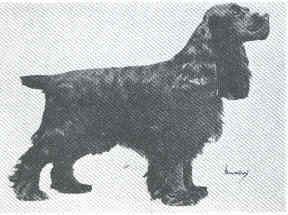
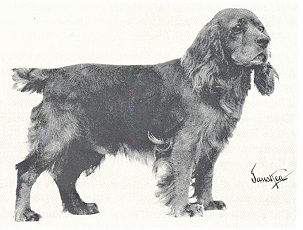
Born May 4, 1935 Brucie was the son of Red Brucie, 


considered to be the father of the modern American Cocker Spaniel.

My Own Brucie won best in show at Westminster in 1940  and 1941 and he won best in the sporting group for three years running, a rare achievement.   Brucie's popularity helped cement the American Cocker Spaniel as the most popular breed in America in the 1940s.  A fact well represented in advertisements from the era, like the one below for a television showing two  kids and a dog, that looks not unlike Brucie, enjoying their new TV.


Sadly Brucie died at the age of 8 from kidney disease.  Since Brucie was a popular sire and his father was the foundation dog for the breed, his kidney disease brings to mind the concern over the "popular sire effect."  Meaning, one dog becomes the sire of too many and thus restricts the breeds gene pool.  Since Cocker Spaniels are prone to kidney disease it is possible that the prevalence of the problem in the breed traces back to Brucie or his father, but of course impossible to know for sure.

Brucie was surely a lovely dog and helped to create one of Americas best breeds.    Below is a video of Brucie's Westminster win:


Saturday, February 2, 2013

Historical Hounds-Balto

87 years ago on February 2 1925, a Siberian Husky named Balto lead his team of Huskies into Nome, Alaska and earned a spot in canine history.   Balto and his teal lead by Norewegian musher Gunnar Kaasen where delivering a serum to treat a diptheria epidemic that had already claimed the lives of several children and threatened to kill more.     Plains and cars could not enter Nome due to the hazardous weather conditions so doctors realized that the only hope for the town was to have the medicine delivered by mushers and their dogs.  

Several mushers and dogs participated in the run, with the most dangerous part being run by a dog named Togo and the musher Leonard Seppala.  
http://frogstorm.com/wp-content/uploads/2010/02/Togo.jpg
Togo and Seppala 

However, as Balto was the last lead dog to run and the one to arrive in Nome with the serum, he got the credit and the fame.  


http://upload.wikimedia.org/wikipedia/commons/4/4f/Gunnar_Kaasen_with_Balto.jpg
Balto and Kassen
Balto and Kassen became overnight sensations.  They were formally thanked by President Calvin Coolidge and a statue of Balto was erected in Manhattan's Central Park, near the Tisch Children's Zoo.


Sadly, fame was not a blessing for Balto and he wound up on Vaudeville circuit where he was neglected and abused.   Eventually, George Kimble, a Cleveland business man, bought Balto and moved him and his compatriots to the Cleveland Zoo, where they received better treatment.  Balto died in 1933 at the age of 14.     His body remains on display in the Cleveland Museum of Natural History.

http://upload.wikimedia.org/wikipedia/commons/8/8b/Balto_CLE.JPG


Dedicated to the indomitable spirit of the sled dogs that relayed antitoxin six hundred miles over rough ice, across treacherous waters, through Arctic blizzards from Nenana to the relief of stricken Nome in the Winter of 1925.
Endurance · Fidelity · Intelligence


Saturday, January 12, 2013

Historical Hounds-The Story of Old Shep

Today marks the anniversary of the death of one of the  most famous American dogs, Old Shep. Immortalized in the famous famous folk song by Ramblin Jack Elliot,  and later sung by Elvis Presley.  While the song tells the story of a fictional boy and his beloved dog, the name is borrowed from the real Old Shep, a homeless mutt who attained great fame in his life time due to his sweet and loyal nature.


http://deestory.homestead.com/files/shep1.jpg

Shep lived for 6 years at The Great Northern Railway Station in Montana. The legend is that he first appeared at the station at the same time a casket was being loaded onto a train.   After that fateful day Shep continued to return to the rail station and seemed to inspect each incoming train, leading the railway workers to believe that Shep was looking for his departed master.  The  workers began to take care of Shep until he was soon  living at the station.   Comfortable around the trains, affectionate and friendly he easily  won admirers.    Thanks to the railway workers who told his story to the many travelers who passed through the station Shep became famous and was featured in Ripley's Believe it Or Not.  His story so impressed people that he began to receive fan mail and gifts as well as many visitors.

On January 12, 1942 Shep, already a middle aged to older dog when he first arrived at the station, was somewhat feeble and suffering from failing hearing when he was struck and killed by an oncoming train.  His funeral was attended by hundreds of mourners.  His obituary was carried in many news papers, even though the news was inundated with stories of the War.  Shep was buried near the rail tracks and his name was spelled out in stones and illuminated at night.  For years  travelers saw the grave through the windows of every departing train, but eventually the  route changed and the grave fell into disrepair.  

In 1994 a large bronze  statue of Shep was erected at the station.  Today visitors continue to bring Shep flowers.
http://www.buckysandbridge.com/2010-1_California/02_Fort_Benton_Shep1.JPG


There is no doubt that like all American heroes Shep's story has been embellished and taken on some mythic elements. Some versions describe Shep waiting at the hospital where his master was ill, for days before the man's death.  Others speak of him simply arriving at the station with the casket.  Stories diverge on the degree of Shep's loyalty and overall  personality.  Some describe him as being in constant mourning for his lost master.  Some individuals who actually new Shep during his life time however, describe him as playful and happy dog who enjoyed his life at the station, and basked in the attention of his many admirers.  No matter how much we love the idea of canine loyalty, I prefer to think of Shep as a happy old dog enjoying his golden years at the railway station.


http://thymegoesby.files.wordpress.com/2009/11/oldsheptrain.jpg?w=500


Friday, November 30, 2012

Happy Birthday Mark Twain

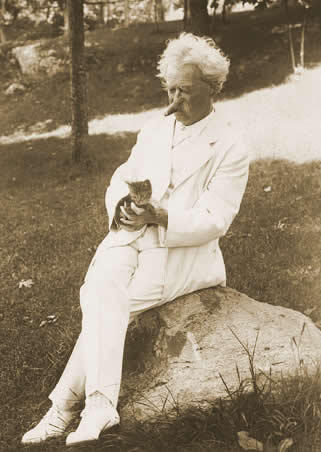
Today marks the 177th anniversary of Samuel Clemens,AKA Mark Twain father of American literature and animal lover (here is the link to our review of Mark Twain's Book of Animals, a great read for any animal lover or Twain fan  link)

I have been studying the traits and dispositions of the "lower animals" (so called) and contrasting them with the traits and dispositions of man. I find the result humiliating to me. 
 http://24.media.tumblr.com/tumblr_lyftw1hcM01qzs32ro1_400.jpg
http://www.twainquotes.com/twain-cat3.jpg

Saturday, November 17, 2012

Happy Birthday Toto

link to picture

Today, marks the birthday of Terry, the dog who gave the ultimate canine tour de force performance as Toto in the Wizard of Oz and forever entered our national imagination becoming a symbol of the canine/child bond.   Born in 1933 Terry was owned by the famous dog trainer Carl Spitz who founded one of the first American dog training schools, The Hollywood Dog Training school, in 1927.  At the time The Wizard of Oz was made Terry was already a star having appeared in six films, including Bright Eyes  with Shirley Temple.  Terry was payed a 125 dollars a week for appearing in the Oz film, more then some of the human actors, and about five times the weekly salary of the average American during the Great Depression.  Of course like everyone involved in the film Terry will be forever associated with The Wizard of Oz and her role as Toto eclipsed all of her other work.  Spitz even officially changed her name to Toto in 1942.   


Terry, or Toto, died in in 1945 having made fifteen films, the last of which was Tortilla Flat based on the novel by John Steinbeck.  Toto was originally interred in a cemetery on Spitz's ranch, but eventually when the Ventura Freeway was expanded the property and cemetery where destroyed.  On June 18, 2011 a permanent memorial to Toto was erected in the Hollywood Forever Cemetery. 


Saturday, October 13, 2012

Happy Birthday PG Wodhouse, Humorist and dog lover

 “Tuppy uttered a stricken woofle like a bulldog that has been refused cake.”
  Wodehouse, Very Good, Jeeves!

October 15, marks the 131st birthday of one of our favorite people--author PG Wodehouse.   Incredibly gifted comic writer and dog lover.  Just look at this picture of him with his dachshund, taken near the end of his life.

http://24.media.tumblr.com/tumblr_lki24j9RYC1qzuc3ho1_500.jpg 

In fact Wodehouse is party responsible for founding one of the largest pet rescues in the NY area, the Bide-A-Wee animal shelter.

http://wodehouse.ru/photo/bp06.jpg

Wodehouse also wrote plenty about dogs, cats, and other animals and some of his best stories  are collected in A Wodehouse Bestiary.


http://photo.goodreads.com/books/1166722827l/16407.jpg


We decided to celebrate PG's birthday with an English style breakfast  (Note this breakfast is for people no matter how many stricken woofles the dogs in attendance make.  However, if the dogs are particularly adorable you may do as we did a slip then a teeny tiny bit of sausage).

Jamie Oliver's One Pan English Breakfast Fry Up (serves 2-3 with big appetites)


2 sausage you can use English style but we used hot Italian, sliced in half and flattened to speed cooking time
1 pint mushrooms sliced
3 plum tomatoes, or one large beef steak tomato
4-5 slices of bacon
2 to 3 eggs
HP sauce

Heat a non stick pan over the highest heat and when its really hot add the sausages, pressing down to flatten them and speed cooking.   Add a little olive oil to the other side of the pan and  put in the sliced mushrooms, season with salt and pepper.   Cook for awhile so the mushrooms start to get  brown.  Add the bacon and keep stirring everything around.  When the bacon is almost done add the sliced tomatoes and again keep stirring everything around.  Flip the sausages over.  When the sausages are nearly cooked through and the bacon is  almost crisp, crack in the eggs and tilt the pan around.  Cook until the whites of the eggs are done and the yolks are just set.  Serve with HP sauce and toast.

After that giant breakfast you will need to take a nice long walk.   Weasley wore his tweed jacket


Doesn't he look like Bertie Wooster?

https://blogger.googleusercontent.com/img/b/R29vZ2xl/AVvXsEhAIZiAXrLP83A2Gg5ABvsycw6WCCgGRhM-5pBZvPYBbHJLG1en2OGT1ZgMS_PrXO9PNHRaJyhNYuqc19Cl7MUADtfb8v_GFPEWqUjmwbX9xsnEQCOW0LGN7Ky_g-obLonVS8wanzbwXgo/s400/Jeeves-n-wooster.jpg

We think PG wold approve.


Saturday, September 22, 2012

Historical Hounds-The Story of Old Drum

A Man's Best Friend is His Dog

Every dog lover knows the saying but not everyone knows about the legal battle that surrounds it.  September 23rd marks the 142 anniversary of  the Old Drum Court Case.  Old Drum was a beloved foxhound owned by Charles Burden who was shot to death by a neighboring sheep farmer, Leonidas Hornsby, who was also Burden's brother in law.   Burden was furious over his dog's death and immediately sued Burden.   The case dragged through the Missouri courts with the men on both sides appealing decisions until it finally reached the State Supreme Court.

In the Supreme Court Trial Burden was represented by George Graham Vest, a lawyer and politician who had served on the Confederate Senate during the civil war and supported the secession of Missouri from the Union.   Vest was a gifted orator and his closing arguments in the trial, known as "Eulogy on The Dog" won the case for Burden and have gone down as one of the most memorable speeches in US courtroom History:

Gentlemen of the jury: The best friend a man has in this world may turn against him and become his enemy. His son or daughter that he has reared with loving care may prove ungrateful. Those who are nearest and dearest to us, those whom we trust with our happiness and our good name, may become traitors to their faith. The money that a man has, he may lose. It flies away from him, perhaps when he needs it the most. A man’s reputation may be sacrificed in a moment of ill-considered action. The people who are prone to fall on their knees to do us honor when success is with us may be the first to throw the stone of malice when failure settles its cloud upon our heads. The one absolutely unselfish friend that a man can have in this selfish world, the one that never deserts him and the one that never proves ungrateful or treacherous is his dog.
Gentlemen of the jury: A man’s dog stands by him in prosperity and in poverty, in health and in sickness. He will sleep on the cold ground, where the wintry winds blow and the snow drives fiercely, if only he may be near his master’s side. He will kiss the hand that has no food to offer, he will lick the wounds and sores that come in encounters with the roughness of the world. He guards the sleep of his pauper master as if he were a prince. When all other friends desert, he remains. When riches take wings and reputation falls to pieces, he is as constant in his love as the sun in its journey through the heavens.
If fortune drives the master forth an outcast in the world, friendless and homeless, the faithful dog asks no higher privilege than that of accompanying him to guard against danger, to fight against his enemies, and when the last scene of all comes, and death takes the master in its embrace and his body is laid away in the cold ground, no matter if all other friends pursue their way, there by his graveside will the noble dog be found, his head between his paws, his eyes sad but open in alert watchfulness, faithful and true even to death.


A statue of Old Drum inscribed with Vest's speech was erected in 1958 and stands outside the court house in Warrensburg, Missouri 

Another monument was built in 1947 in Blue Springs, Missouri in the location that Drum's body was found after being shot.


Both monuments are frequently mentioned in guides to America's road side attractions.


Saturday, September 15, 2012

Happy Gotcha Day Rin Tin Tin

94 years ago today a US Air Force WWI pilot was searching through the rubble of a bombed out German Airfield in France when he discovered a litter of German Shepherd puppies.  The pilot, whose name was Lee Duncan, adopted two of the puppies, a male and a female.  Sadly the female, Nanette, died shortly thereafter, but the male, went onto become the most famous canine film star of all time---Rin Tin Tin. 

Happy Gotcha Day to Rin Tin Tin! 


If you want to read our other posts on Rinty, here are the links

Rin Tin Tin The Life and The Legend-Book Review

Historical Hounds-Rin Tin


Saturday, July 28, 2012

Historical Hounds-Bob The Railway Dog


 Sunday marks the anniversary of the passing of an interesting historical hound, this one from Australia.... Bob the rail way dog.   


 Like many of histories greatest characters, Bob's origins are somewhat mysterious.  The generally excepted story is that  he was a stray who was adopted  along  with some other dogs in an attempt to deal with a surplus rabbit population problem.  Eventually, Bob was taken in by a man named William Ferry who worked for the railroads and who introduced him to train travel.

  Bob enjoyed trains so much that when Ferry was promoted to station manager he continued to let his dog ride the rails.   Bob basically became a stray who belonged to no one, but was at the same time the pet of all the railway workers in Australia.  He loved long distance trips and traveled through all the states of Australia.  Bob liked to have a nearly empty train compartment to ride in so he could stretch out comfortably.  He would bark at the passengers until they cleared out a section for him. What is most remarkable about this is that the train workers rather then disciplining the dog would encourage the human travelers to make room for him. Although he was a friendly dog, Bob's vigorous bark lead some people to fear him.   However, for every person who feared him another was completely won over but his boisterous and adventurous spirit.  


As Bob's travels increased so did his fame.  He was an honored guest at the opening of one rail station.  And was the subject  of this poem (author unknown)


Home-keeping dogs have homely wits,
Their notions tame and poor;
I scorn the dog who humbly sits
Before the cottage door,
Or those who weary vigils keep,
Or follow lovely kine;
A dreary life midst stupid sheep
Shall ne'er be lot of mine.

For free from thrall I travel far,
No fixed abode I own;
I leap aboard a railway car;
By every one I' know;
Today I am here, tomorrow brings
Me miles and miles away;
Borne swiftly on steams rushing wings,
I see fresh friends each day.

Each Driver from the footplate hales
My coming with delight;
I gain from all upon the rails;
A welcome ever bright;
I share the perils of the line
with mates from end to end,
Who would not for a silver mine
Have harm befall their friend

Let other dogs snarl and fight,
And round the city prowl,
Or render hideous the night
With unmelodious howl.
I have a cheery bark for all,
No ties my travels clog;
I hear the whistle, that's the call
For Bob, the driver's dog.


A true adventurer, Bob embodied the independent Australian spirit. He was not afraid of risk and sustained several injuries while jumping trains.  He lost an inch of his tail in one accident, hurt his leg several times while falling of cars, and once his coat caught fire.  Despite all of these accidents he lived to the advanced age of 17.  When he passed away on July 29, 1895 his death was mentioned in papers as far away as England, where he was called the "King of Outcasts." 


Bob's collar is displayed at the National Railway Museum in Australia, 
the inscription reads: 
Stop me not, but let me jog, For I am Bob, the drivers dog


  A statue of Bob stands in Peterborough Australia.


Source: Wikipedia


Here is our tribute to Railway Bob-a picture we took a few years ago in front of an abandoned train in Liberty State Park. 

http://im1.shutterfly.com/media/47b9d724b3127ccef85eb9908f1900000040O00GaM2LNw4Yg9vPhw/cC/f%3D0/ps%3D50/r%3D0/rx%3D550/ry%3D400/


Have plenty of adventures this weekend, just like Bob!

Saturday, July 14, 2012

Warrior Poodles-Who Would Have Thought?

In honor Bastille Day I'm Reprinting a Post From Last July, a Fun History Lesson on France's most famous breed:

The urban hounds love a good natured battle, after all nothing beats wrestling with your friends.  The snow in particular seems to bring out Norbert and Bob's warrior sides (don't worry they were just playing, even during the last pic, which admittedly looks pretty scary):


Maybe its just to hot too wrestle in the summer time.  


Anyway today marks a big day in battle doggie history.   When we see the poodle:


https://blogger.googleusercontent.com/img/b/R29vZ2xl/AVvXsEjbrWJJG82-zHehfKv3EsMSvQBN4QyedChRa2djFuETS_K3cWsv0HM5I1mOt2np3hiBr8I3GonaIY6ioFasirFtlA5GcoQmWaJVuOww1WjYHbif6cHYOXFSNKJDVecL9VYL8cUAZE-aCks/s400/poodle-dog.jpg

Most of us think of glamour, hair cuts, dog shows, and companionship.  Those who are more educated about how intelligent, athletic, and active these dogs are think of rally-0, agility, hunting, and therapy dog work:

http://rpoodles.com/img/pagility2.jpg


http://thepoodleanddogblog.typepad.com/.a/6a00d83451580669e2010535b47b43970c-pi


http://www.redhuntingpoodles.com/images/testimonialpicture.jpg
http://www.arielkennels.com/images/lisa168_68091.jpg


(links for images  therapy poodle link, agility poodle link, hunting poodle link,  rally o poodle link)


But when we think of poodles--we don't usually think of battles or war.   Well, we are wrong.   It turns out that one of the most famous warrior dogs of all time was a poodle.   

http://upload.wikimedia.org/wikipedia/commons/thumb/2/28/Wenceslas_Hollar_-_A_poodle,_after_Matham.jpg/300px-Wenceslas_Hollar_-_A_poodle,_after_Matham.jpg
link to picture

Today, July 2, marks the anniversary of the Battle of Marston Moore.  This battle was fought during the first English civil war in 1644.  During the battle Boye, a hunting poodle, owned by Prince Rupert of the Rhine lost his life.

During his life Boye was a very famous, and very feared, canine.   He accompanied Rupert into battles and there was a great deal of negative propaganda about Boye put out by the Parliamentarians, the group that opposed Prince Rupert and the other Royalists.    Among the rumors circulated about Boye where charges that he was a witches familiar, could turn invisible and thus spy on the Prince's enemies, was a shape shifter, and even that he was the Devil himself.   The Royalists however loved Boye and adopted him as their official mascot even giving him the honorary rank of Sergeant-Major-General.

 http://ussi9mm.files.wordpress.com/2009/08/prince_rupert_-_1st_english_civil_war.jpg
 link for image

Sadly during the Battle of Marston Moore Boye escaped the Royalist camp and chased after Prince Rupert into battle.  The battle went badly for the Royalists and Boye was one of many soldiers who lost their lives. 


http://www.poodlehistory.org/BDEATH.GIFBy all accounts Prince Rupert was devastated by the death of his dog.   Perhaps Boye was a magic charm for the Royalists because after his death they were defeated by Parliament and from 1649-1660 England was a republic.   Prince Rupert survived the war and was employed by the King of France to fight the Spanish during the thirty years war.
After the death of Parliamentary leader Oliver Cromwell in 1658 England fell into disarray.   Prince Rupert returned to England to fight for King Charles II.  This time, even without the help of a magic poodle, the Royalists where successful and the monarchy was restored in 1660.  Prince Rupert died of natural causes in 1682 at the age of 63.